
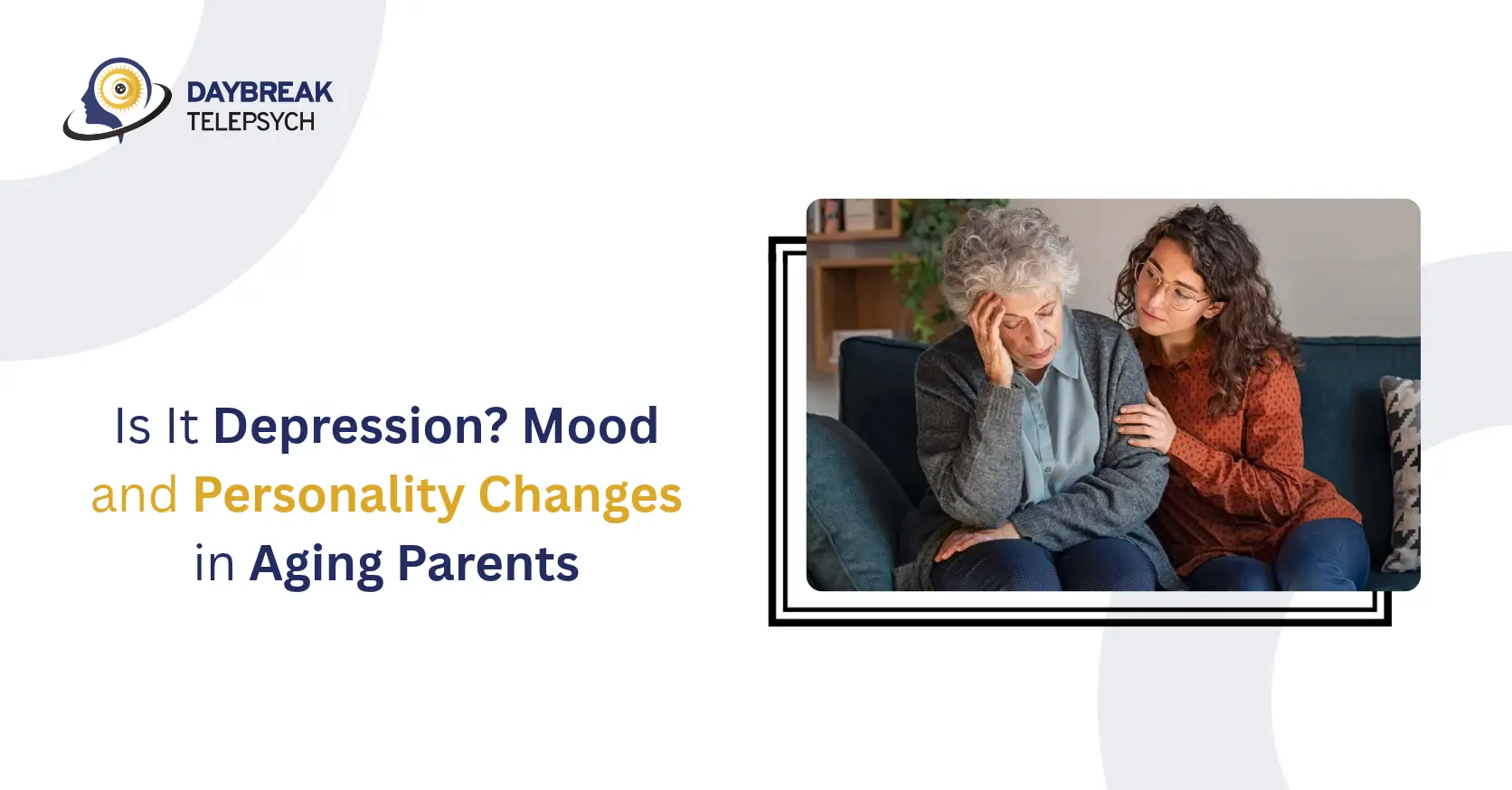
Your mother snaps over small things she used to laugh off. Your father stays in his room, stops calling old friends, and says he is “just tired.” It is easy to put this down to getting older. Sometimes it is. But a real change in who your parent is, not only in what their body can do, is not a normal part of aging.
Many of these changes have a mental health cause. Depression, anxiety and the mood and behavior changes that come with dementia are common in later life. They are also easy to miss, because in older adults they often look like irritability, withdrawal or physical complaints rather than sadness. The good news is that they are treatable at any age.
This guide covers when to get urgent help, why a medical check-up comes first, the mental health causes families most often miss, and what a psychiatric evaluation for an older adult involves.
When to get help right away
Some changes cannot wait for an appointment. Call 911 or go to the nearest emergency room if your parent has:
- Sudden confusion, trouble speaking, or trouble understanding others, especially with numbness or weakness on one side, vision problems, loss of balance, or a sudden severe headache. These are warning signs of a stroke (CDC).
- Confusion that comes on over hours or a few days, or swings between drowsiness and agitation. This can be delirium, a sudden state of severe confusion caused by an underlying illness such as an infection or a medication reaction (MedlinePlus).
- Talk of death, hopelessness, or harming themselves or someone else. Call or text 988, the Suicide and Crisis Lifeline, which is free and available 24/7. For immediate danger, call 911 (NIMH).
Do not dismiss that last point because of your parent’s age. In the US, men aged 75 and older have the highest suicide rate of any age group (CDC, 2024 data).
Start with a medical check-up
Before assuming a change is psychological, ask your parent’s primary care doctor to look for physical causes. Infections, body chemistry problems and medication reactions can all change mood and thinking (MedlinePlus).
Medications deserve special attention. As we age, the body handles medicines differently, and combining prescriptions, over-the-counter products and supplements can cause problems (NIA). Bring a complete list of everything your parent takes to the appointment. If you suspect a side effect, do not stop the medicine on your own; talk to the prescriber first.
If the check-up does not explain the change, or the doctor suspects depression, anxiety or dementia, that is when a psychiatric evaluation can help.
Mental health causes families often miss
Depression that does not look like sadness
Depression is common in older adults, but it is not a normal part of aging (NIA). In later life it often shows up as:
- Irritability, restlessness or a short temper
- Low energy and constant tiredness
- Aches and pains with no clear physical cause
- Losing interest in hobbies, friends or family
- Changes in sleep or appetite
Older adults and their families often put these symptoms down to physical illness, so depression goes undiagnosed (CDC). If several signs last more than two weeks, it is time to talk to a doctor. Most older adults improve with treatment (CDC).
Grief that does not ease
Losing a spouse, close friends or independence is part of later life, and grief is a normal response. When grief, isolation or loneliness persist, they can lead to depression or anxiety (NIMH). If your parent seems stuck, or stops caring for themselves months after a loss, it is worth getting help.
Anxiety
Anxiety in older adults is often expressed as constant worry about health, money or family, along with irritability, trouble sleeping, and physical complaints such as headaches, stomachaches or muscle tension (NIMH). It responds well to therapy, medication, or both.
Mood and behavior changes with dementia
Dementia is not only about memory. It can bring:
- Agitation and aggression, often triggered by pain, depression, stress, medications, or a noisy or unfamiliar setting (NIA)
- Paranoia, such as believing someone is stealing their things when they have misplaced them (NIA)
- Hallucinations, such as seeing a relative who has died. An illness or medication can also cause these, so tell their doctor (NIA)
- Depression, which may affect up to 40% of people with Alzheimer’s or another dementia (Alzheimer’s Association)
Some dementias start with personality change rather than memory loss. Frontotemporal dementia often begins with impulsive or inappropriate behavior and losing interest in family. It tends to appear earlier than other dementias, most often between ages 45 and 64 (NIA).
Alcohol
Older adults can feel the effects of alcohol more strongly without drinking more than before. Alcohol can interact dangerously with sleep, pain, anxiety and depression medicines, and heavy drinking can cause forgetfulness and confusion that is mistaken for dementia (NIA).
Is it depression or dementia?
Families ask this question more than any other, and the honest answer is that it can be hard to tell at home. The two conditions share symptoms: withdrawal, losing interest in activities and trouble concentrating (Alzheimer’s Association). They can also happen together.
The difference matters because depression is treatable. Depression, anxiety and stress can cause memory problems that usually improve once the mood problem is treated. The same is true of memory problems caused by low vitamin B12, thyroid problems, alcohol or medication side effects (NIA).
There is no single test for depression in someone with memory problems. Sorting it out takes a careful medical and psychiatric evaluation, and a geriatric psychiatrist can help (Alzheimer’s Association).
What a psychiatric evaluation involves
Geriatric psychiatry is the medical specialty focused on evaluating, diagnosing and treating mental health conditions in older adults (American Association for Geriatric Psychiatry).
A psychiatric evaluation for an older adult usually includes:
- A detailed history. When the changes began, how fast they developed, and what else changed around the same time, such as a loss, a move or a new medication. Family input is often very helpful here.
- A medication review. Every prescription, over-the-counter medicine and supplement is checked for side effects and interactions that could affect mood, sleep or thinking.
- Screening for mood, anxiety and memory. Short, standard questionnaires help show whether depression, anxiety or cognitive problems are likely.
- Coordination with the primary care doctor. If a medical cause is possible, the psychiatrist may recommend lab tests, imaging or a referral.
- A treatment plan. Depending on the findings, this may include therapy, medication, changes to current medications, and support and education for caregivers.
Treatment works in later life. Most older adults with depression improve when treated (CDC), and treating depression in people with dementia can significantly improve their quality of life (Alzheimer’s Association).
Getting care with Daybreak Telepsych
Getting to appointments can be hard for older adults, especially those with mobility problems, memory loss or no one to drive them. Video visits let your parent see a psychiatric clinician from home, using a computer, smartphone or tablet with a camera. A family member can help with setup.
Daybreak Telepsych offers:
- Psychiatric evaluations for depression, anxiety and related concerns
- Second-opinion consultations
- Medication evaluations and reviews
- Refills of non-controlled medications, when clinically appropriate
Family involvement. Your parent is the patient, so they need to agree to the visit and to family taking part. With their agreement, or if they do not object, we can include you in the conversation (HHS). If you are your parent’s legal healthcare representative, let us know when you book.
What telehealth cannot do. Physical exams, lab tests and brain imaging still happen in person, usually through your parent’s primary care doctor. We work alongside that doctor rather than replacing them.
We are not an emergency service. In a crisis, call 911, or call or text 988.
If your parent’s mood or behavior has changed, you do not have to sort it out alone. Contact Daybreak Telepsych to schedule a visit.
Frequently asked questions
Is it normal for an older parent’s personality to change?
Some change is normal: moving more slowly, needing more rest, or preferring smaller gatherings. A major shift in personality is not a normal part of aging and should be checked by a doctor.
My parent is irritable all the time. Could that be depression?
Yes. In older adults, depression often shows up as irritability, restlessness or tiredness rather than sadness. If it lasts more than two weeks, talk to their doctor.
Should we see a psychiatrist or their regular doctor first?
Usually their regular doctor, to rule out physical causes such as infection or medication side effects. A psychiatrist is the right next step when a mental health condition is likely, or when the cause is still unclear.
Can antidepressants help someone in their 70s or 80s?
Often, yes. Depression is treatable at any age. Doctors choose medicines and doses carefully for older adults to limit side effects and interactions, and therapy is an option too.
My parent refuses to see anyone. What can I do?
Start with their primary care doctor, which may feel less threatening. Frame the visit around a specific concern such as sleep, energy or pain, and offer to come along. A video visit from home can also feel easier.
Disclaimer: This article is for general educational purposes only. It is not a substitute for professional medical advice, diagnosis or treatment. If you think someone is in danger, call 911. For thoughts of suicide, call or text 988.
References
- Alzheimer’s Association. Depression.
- American Association for Geriatric Psychiatry. About Geriatric Psychiatry.
- Centers for Disease Control and Prevention. Depression and Aging.
- Centers for Disease Control and Prevention. Signs and Symptoms of Stroke.
- Centers for Disease Control and Prevention, National Center for Health Statistics. Changes in Suicide Rates in the United States From 2023 to 2024. NCHS Data Brief No. 572.
- MedlinePlus. Delirium.
- National Institute on Aging. Depression and Older Adults.
- National Institute on Aging. Taking Medicines Safely as You Age.
- National Institute on Aging. Memory Problems, Forgetfulness, and Aging.
- National Institute on Aging. Coping With Agitation, Aggression, and Sundowning in Alzheimer’s Disease.
- National Institute on Aging. Alzheimer’s Caregiving: Coping With Hallucinations, Delusions, and Paranoia.
- National Institute on Aging. What Are Frontotemporal Disorders?
- National Institute on Aging. Facts About Aging and Alcohol.
- National Institute of Mental Health. Older Adults and Mental Health.
- National Institute of Mental Health. Generalized Anxiety Disorder: When Worry Gets Out of Control.
- U.S. Department of Health and Human Services. HIPAA: Family Members and Friends.
